Book Two · The Quest for I-Ching
Three thousand years is long enough for anything to become a story.
The children of the river cities know Doctor Boon. He is the clever old man in the tales their grandmothers tell — the one who tricks the sky into closing its mouth, who argues with a storm until the storm forgets its own name. No one believes he lived. Clever old men in stories never do.
In the south, they burn candles to a fire saint. She has a hundred names now, and none of them is Nyra. Her shrines are warm in winter. Her priests will tell you she was born from a flame that refused to go out, which is close enough to true that the truth stopped arguing.
There is a forest in the west that no map agrees on. Travelers say the trees stand in patterns, that the roots hold the shape of something that once decided to stop walking. Scholars call this pareidolia. The forest calls it nothing. It has been silent for a very long time, and the name Virelia is not written anywhere except in the way the branches lean.
Beneath a cold sea lies a ruin that half the universities of the world insist never existed. The other half have spent lifetimes diving for it. Fishermen avoid the water above it, not because it is dangerous, but because on quiet nights the water sounds like pages turning.
Somewhere, a drinking song survives about an orc who laughed at the end of the world. The verses change from tavern to tavern. Only the laugh stays the same.
And in every language spoken under the sky, there is a word for the fear that has no shape. Arkhelion, the old tongues called it. Mothers use it to name the thing in the dark that cannot be pointed at. They do not know they are pronouncing a name.
This is what three thousand years does. It does not erase. It digests.
The world rebuilt itself the way worlds do — carelessly, magnificently, on top of its own graves. New nations rose and fell and rose again. New gods were invented, worshipped, filed away. The wound in the sky, where the rift once opened like an eye, cooled into a ring of faint stars. Astronomers named the constellation The Closed Eye. It became a symbol of peace. Sailors steered by it. Lovers pointed at it. A story that ended.
Only one place in the world never accepted the ending.
The monastery has no founding date because it is older than the counting of dates. It sits where three mountain ranges fail to meet, in a valley that appears on no map for the same reason the western forest appears on none: the world has agreed, without discussing it, to look elsewhere.
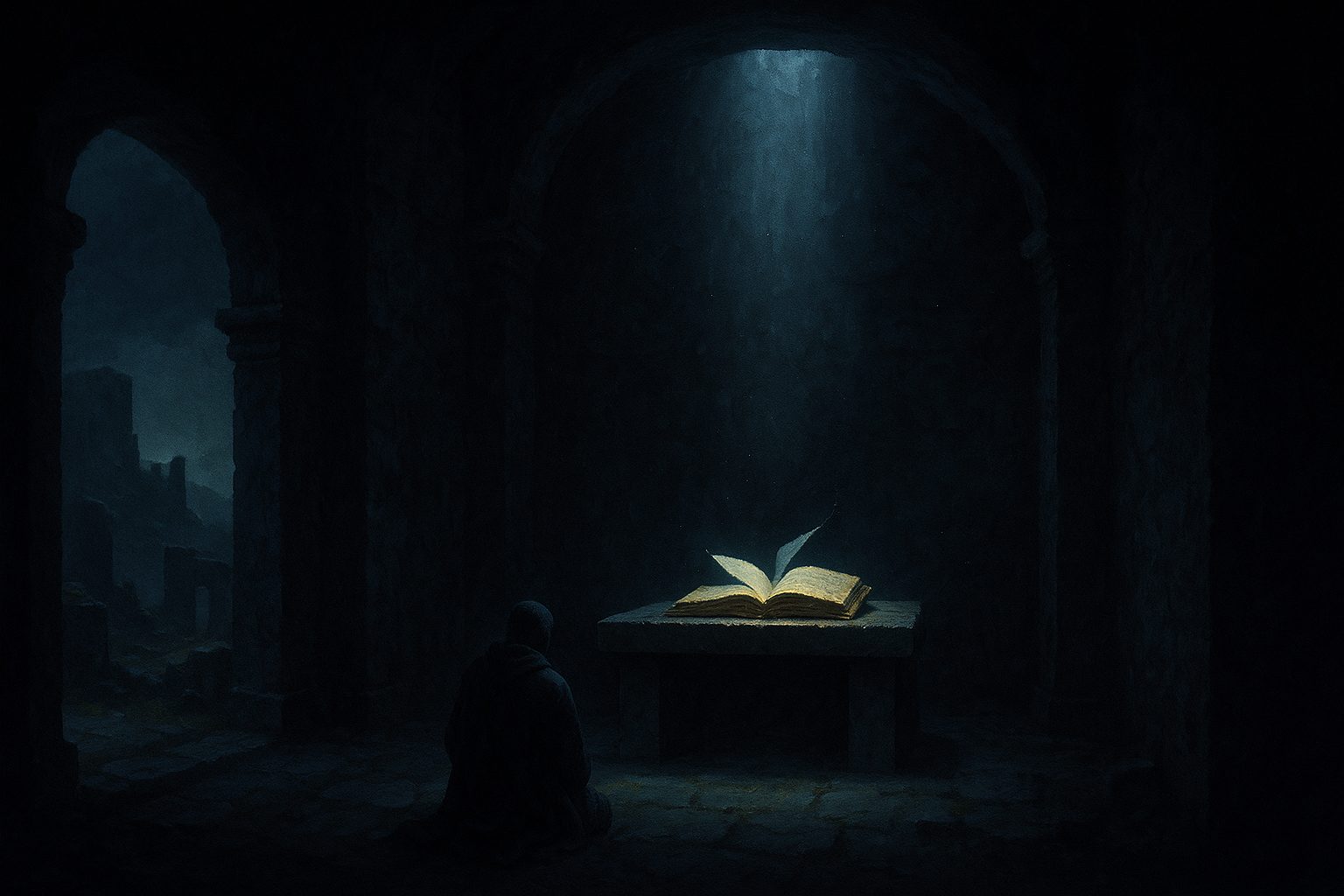
Inside, in a room with no door, a book lies open on a stone table, and the wind turns its pages.
The monks who keep the book do not read it. That is the first rule and the oldest one. They listen. For a hundred generations they have knelt at the edge of the doorless room and listened to the sound the pages make — and for three thousand years, the sound has been the same. A single low note, patient as geology. The monks are taught it as children. They hear it in their sleep. It is the sound of a held breath.
Last autumn, the note changed.
Not loudly. Not suddenly. A half-tone's drift, the kind of change only a hundred generations of listening could catch. The oldest monk, who had knelt at that threshold for sixty years, heard it and wept without knowing why. The pages began to turn faster. The hexagrams — the six-lined figures that had rearranged themselves in the same slow patterns for millennia — began forming sequences that appear in no commentary the order permits itself to read.
Except one. There is a forbidden shelf, as there is in every honest library, and on it a commentary so old its author is only a hand. The oldest monk broke a rule smaller than the first rule, and looked, and found the sequence there, named in ink gone brown as dried blood:
The Sequence of Returning. The pattern that plays before a cycle repeats.
Deep beneath the world, in the places where geology becomes theology, twelve shards of a dead star have spent three thousand years thinking.
They fell during the First Catastrophe — this much the fire saint's priests have right. And they were silenced — this much the drinking song has right. But silence is not absence. Silence is a room in which something can concentrate.
The signal that once screamed across the sky had never, in all the civilizations it had swallowed, been refused before. It did not understand refusal. So it studied. It took the counter-harmony that had wounded it — the frequencies of resistance, the shapes of defiance, the sound of six impossible creatures saying no in unison — and it composed with them. Patiently. Pressed between tectonic plates and the roots of dead volcanoes, in the dark, for thirty centuries.
The old signal corrupted. It broke what it touched, and breaking is loud, and loud things get fought.
The new signal has learned better. The new signal perfects.
The first signs are beautiful. That is the point of them.
A village in the eastern terraces wakes to find every crop in full bloom, overnight, out of season, without blemish. The farmers weep in the fields. A festival is declared.
A river that has drowned its floodplain every spring for four hundred years settles, without cause, into perfect equilibrium. The engineers sent to study it find nothing to study. The water is simply, finally, reasonable.
A child born deaf begins to hear. Her parents fall to their knees. What the child hears, she cannot explain to them — a melody, she says, coming from everywhere and underneath. No one else can hear it. She hums it constantly. Her parents find they sleep better when she does.
And on a border where two kingdoms have traded sons for six generations, both armies wake one morning, look at one another across the standing stones, and lay down their weapons — smiling, calm, unable to remember what the quarrel was. The chroniclers on both sides record it as a miracle.
It is recorded as a miracle everywhere. Everywhere except one valley that appears on no map, where an old man kneels at the edge of a doorless room and listens to a book turn its own pages faster and faster, and understands that the world is not being blessed.
It is being tuned.
The monastery does not send messengers. It has none to send, and no message that could be believed.
The book sends itself.
This is what the forbidden commentary says, in ink gone brown: when the Sequence of Returning plays, the eight lines of change go out into the world like roots through stone, and they find the eight souls whose natures ring true to them — not the mightiest, the commentary is very clear on this point, and not the wisest, and not the most worthy. The trigrams do not measure worth. They measure truth. A soul that is what it is, all the way down.
Eight people feel it, in eight places, in eight different ways.
A general on a high balcony hears his own heartbeat fall out of rhythm with the drums below, and cannot say why that frightens him. An old woman kneels in her garden and feels the ground beneath her palms take a slow breath. A thief pauses over still water because her reflection has stopped waiting for her. A judge lifts his lantern and watches the shadows refuse to lie. A girl on a burning road hears thunder in a cloudless sky pronounce the first syllable of her name. A monk in a doorless room finally, after forty years, looks down at the page. A stonemason feels his mountain shift its weight, the way a sleeping giant turns toward a sound. And in a lake at the edge of a pleasure city, a woman watches her own face smile at her a half-second before she smiles.
Eight summons. No words. No promises. Only a direction, felt in the marrow, pointing at a valley the world agreed to forget.
They are not chosen because they are powerful.
They are chosen because they are true.
Three thousand years pass. The world is still being written.