Book Two · The Quest for I-Ching
There are eight schools, and there have always been eight schools, and the number is not a coincidence — it is a debt.
A student arrives believing that fighting is a matter of knowing many things. The first year is spent unlearning it. What you know was never the question. The question is what your body is currently shaped for.
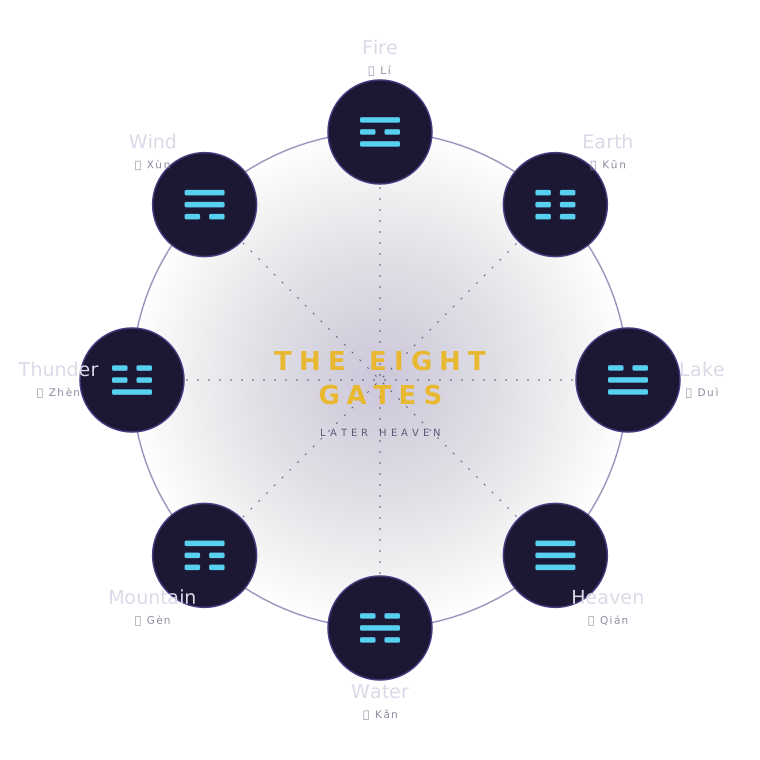
Stand in Fire, and Fire's work comes to your hands without being called. The gates on either side of you will answer, but roughly — like a word spoken in an accent you half remember. And the gate directly across the circle, the one facing you, the one you can see perfectly well from where you are standing, is closed. Not difficult. Closed. An adept of Fire standing in Fire cannot do Water's work at all, and it does not matter how many times she has watched it done.
So you move.
Stepping to the gate beside you costs nothing but time, and time is the thing you have least of. Crossing the circle outright costs breath you would rather have spent striking. And whatever you had built where you were standing — the posture, the settled weight, the thing that took three exchanges to establish — does not travel with you. You arrive with new ground and empty hands.
Which leaves breath
Everything costs breath. Breath returns on its own, slowly, the way it does. There is a faster way, and every school teaches it, and every school teaches it with the same warning attached: to take a great breath is to stop, and to stop is to be seen stopping. The one across from you knows precisely what you have just bought and precisely what it cost. For the length of one exchange you are a person standing still.
Most of what happens in a real match happens inside that decision.
Two ways to lose
The old texts are careful to keep them apart.
A fighter can be worn down. Strikes land, and land again, and the body keeps a running total, and the total comes due. This is the honest way and the slow one, and it is what every student imagines when they imagine winning.
The other way never touches the guard. It takes the base. A throw, a sweep, a hand at the elbow that turns a step into a fall — none of these do much harm. What they do is take away the ground. A fighter whose balance is gone is not injured. She is simply, for a moment, no longer standing the way a person stands, and in that moment the school across from her does not need to be strong. It only needs to be there.
The founders' war was won the first way. Everyone remembers it that way, because that is how it was written down.
The masters who came after have their own opinion.
Why they cannot borrow
A master of Thunder may learn Mountain, because Mountain stands beside Thunder. She may learn Wind for the same reason. She cannot learn Lake — not because she is forbidden, but because Lake is across the circle from Thunder, and a body that does the one cannot do the other. Three gates. That is the whole of a master's world.
It is why no two of the eight fight alike. It is why two masters on opposite sides of the wheel have, between them, nothing whatsoever in common: not a technique, not a stance, not one shared way of standing in a room.
They have the circle.
That is all anyone has.