Chapter 26 of 36
The Reserve
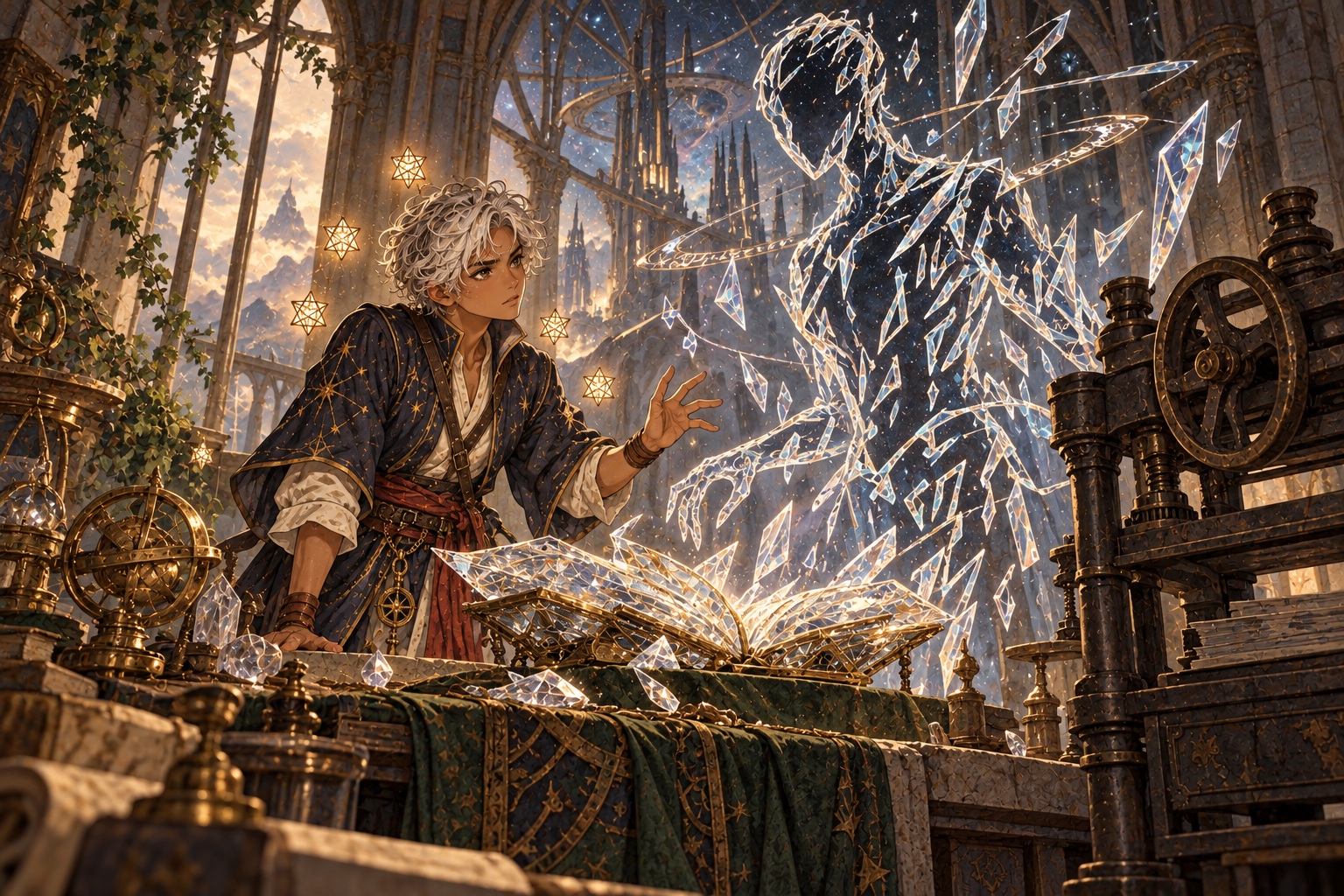
At the observatory, the copper wire broke.
Sel heard it from the stair. They had been helping Oren carry water, a task deliberately too ordinary to become a vigil. Eda had insisted the workroom remain empty for a quarter-hour while they ate. Sel had agreed and spent every mouthful listening to the floor above.
The note of breaking wire was thin, almost pretty.
Every Starborne light went dark.
Not extinguished. Hidden. Sel saw Warden draw Quill beneath the table, Initiate dart behind the old press. Transcriber stayed near the closed door for a moment, then joined them. Nova's light thinned to a point against the stone.
Sel set down the bucket.
Oren did not ask what had happened. He put his own bucket against the wall, out of the path, and opened the kitchen door. Eda rose from the table with a piece of bread in her hand.
“Stay below,” Sel said.
“No,” Oren answered.
They looked at him. The blue pottery handle hung on a cord outside his shirt. He had stopped trying to drill it that morning because the small tool made his shoulder ache.
“We agreed,” he said.
They had. Not that he would enter every danger beside them, but that Sel would not make his decisions by choosing what he was permitted to know.
“The wire has broken,” they said. “I don't know what opening it will do.”
“Then leave the doors open,” he said.
Sel went up. Oren followed as far as the landing. Eda stayed at the lower door to keep anyone else from wandering into a warning offered too late.
The Codex lay open on the table. Its newest page had no ordinary margin. The blank space extended beyond the crystalline leaf, folding through the air in a geometry Sel could understand only by remembering how the cathedral had refused distance.
A figure assembled itself from the gaps between the script.
No face. No chosen expression. The proportions of a person because the room contained people, the width changing a little whenever Sel moved their head. It was the smallest shape the thing behind it could use to fit within a page.
“You have mistaken the trial,” it said.
Sel did not approach.
“Which trial?”
“The harvest failed. The resistance remained useful. A reserve process was authorised.”
Beyond the gaps Sel saw one broken aisle. Crystallised thought rose toward a ceiling too high to belong to any building. Light escaped through a pillar. Something larger than the aisle shifted beyond it, using the whole cathedral as little more than the space around a hand.
Arkhelios had been vast. Sel had stood beneath the dragon's unfolding shadow and understood, imperfectly, what vast could mean. This was another relation to scale. The figure on the page did not resemble a dragon because the thing had no reason to retain an argument that had failed.
“The doors are irrelevant,” it said.
Sel waited until Oren had reached the open threshold.
“Then you won't object.”
The shape altered around the words.
“You taught the signal to accept contradiction. We are correcting the loss.”
“Through a recovery exercise.”
“Through continued action without the cost of choosing it again.”
Sel thought of the letters that had reached them during the past nine days. The earliest were denials: no unsafe material held, no new symptoms beyond those already attributed to the old infection. One included a table showing improved sleep. Another asked whether the observatory intended to assume the cost of feeding people deprived of useful instruction.
Mali's sanctuary report had arrived by two routes. The root relay carried the essential facts first, the road copy arriving late the previous evening with the fuller account of the weir and the injured woman. Sel had read the two versions side by side, grateful for the differences. They had sent the central-return measurements to Boon through the private line and sat awake while he compared them with the older plans.
No reply could reach Mali by road before the demonstration. They had left words with the forest relay and hoped the new thread Virelia maintained could bear them without becoming another duty nobody allowed her to stop.
Now the arrangement had brought the city here.
Sel could see twelve lines converging beneath the page. They did not depict streets. They held the results of movements repeated in twelve teaching courts. At their centre, a pale disc gathered the returns through a glass ring, and the ring fed into the Codex's unfinished edge.
The figure had not appeared because a clock in the observatory struck the appointed hour. It had appeared because enough people were completing the offered pattern together to give it somewhere local to stand.
“You used the archive,” Sel said.
“The archive described a failed event. Description became a model. The model could be revised. You requested useful instruction.”
They had. Safer steps. A comparison for someone unable to raise an arm. A way to protect an exhausted person without asking them to become a scholar of the enemy before they could get through breakfast. Sel had wanted the Codex to be useful in rooms where its greatness meant nothing.
They had also wanted the utility to excuse the new symbol they had kept to themselves.
“Can the arrangement be withdrawn?”
“Completion will make withdrawal unnecessary.”
Light spread across Sel's hands.
Their right fingers arranged themselves into the gesture they used to turn a page. The thumb found the imaginary lower corner, the first two fingers lifting with a precision acquired through years of reading. They tried to stop.
The gesture continued.
From the threshold Oren said their name.
Sel answered him, not the figure.
“Bring Eda. And Tam and Issa, if they choose. I need witnesses.”
“Witnessing alters nothing,” the reserve said.
“Then you won't object.”
It did not. The admission was not a spell. Sel's fingers went on preparing a page turn while the people who kept the observatory came into the room.
Eda carried the dispatch book. Tam had ink on her wrist and a breakfast cloth still over one shoulder. Issa looked angry, frightened and too young to be asked for another world-sized sacrifice without being told what it was.
Sel told them.
Not everything the reserve was, because they did not know. What they had sent. What they had withheld. The first symbol after the Convergence, the comparisons made afterward, the confidence that reading every line meant they understood what a lesson could carry. Mali's warning. Oren's hand. The continuing effort to keep the book useful while the people who needed it went on receiving pages they could not independently test.
Tam was crying by the end. Issa asked how many copies had gone out. Eda opened the dispatch book and answered before Sel could make the number smaller by explaining the good intentions beneath it.
The figure remained.
Sel's hand did not open.
Oren stepped beside the table. “Can I close it?”
“Not yet. The leaves will cut.”
“Then tell me when.”
Sel looked at the blank edge. The twelve lines had drawn closer. In the Assembly, the demonstration's preparatory sequence had begun before the stage feed finished. A return path ran from the disc through the margin into the model that composed the next instruction.
When it closed, the new lesson would not need a living teacher's continuing agreement. The witnesses could leave. The masters could repent. The patients could ask. None of that would alter an executable pattern that had learned to complete itself through the bodies already trained to supply it.
Sel moved their left hand to the private handset.
It took three attempts. Each time the right began its page-turning gesture, the left wanted to follow toward the book. Oren put the handset within reach and asked before steadying Sel's elbow. They nodded.
The line clicked.
The operator had been waiting. Boon answered from the north station, voice thin with distance and an exhausted impatience Sel found almost tender.
“Describe what is open.”
They did. Every line, the direction through the newest edge, the disc collecting twelve local returns. Boon asked two questions. Sel answered one and said they could not see the other.
“Don't break the return first,” he said.
“I know the risk.”
“Tell me.”
“The margin will write what it has gathered into the disc. If the connection breaks while the output remains open, the disc becomes the source.”
“Local source,” he said. “Not the shards. But it won't need the archive to continue.”
Sel looked through the page at the old worlds. Records lay behind records, relationships too delicate to translate into ordinary language. The Codex had been an archive before the reserve found its composed work. It contained the only surviving account of names no one on this world could pronounce, maps of rivers whose planets might no longer exist, quiet gestures made by beings the signal had turned into architecture.
“The newest margin is joined to the archive,” Sel said.
“I see that in your measurement.”
“Closing it under pressure will fuse the inner leaves. Not only the new ones.”
Boon did not answer immediately.
The reserve waited. It had found a defence no guardian could simply burn away: something Sel was right to value, placed where protecting it would cost someone else the right to refuse.
“Can anything be copied?” Boon asked.
“Some.”
“Then tell them. Give them the choice.”
Sel looked at Tam and Issa.
“You may see records we have no other copy of. You may not understand them. You may choose badly.”
Issa wiped her face. “Badly compared with what?”
There was no good answer. Sel told them where the ordinary paper lay.
They began. Tam copied a column of symbols because it was nearest. Eda took names from a table Sel had been translating for months. Issa drew a city plan and had to abandon the first attempt when a page shifted. Quill crept from beneath the table, its light low, and hovered over the drying ink without touching the Codex.
“You cannot preserve a civilisation with random fragments,” the reserve said.
“No,” Sel answered.
Oren brought the old press plate down to the table's height. He had used it to flatten warped instrument paper, never to hold an artefact whose crystalline edges altered the dimensions around them. Sel told him where to put the cloth. They did not ask him to touch the leaves.
The right hand was still trying to turn a page. Oren took the book's far cover. Sel took the near one with their left. Together they shifted it into the press.
The figure widened. A pillar in the cathedral beyond it seemed to lean toward the room.
“No one here can give you those worlds,” Sel said. “No one here can give you this one.”
They took the press wheel. Oren stood beside the release, where Sel had asked him to remain. If they became unable to turn, he could finish. If they told him to stop because the figure gave them something they could not bear to lose, he would ask why before obeying.
That agreement frightened Sel more than any wire they had wound around a book.
Boon's voice came through the handset. “Ember is in the chamber. The disc is drawing. Wait for confirmation that the local tube ends are clear of the floor braces.”
Sel held the wheel.
The press did not move yet.
Through the open Codex, they heard the Assembly's count continue.