Chapter 27 of 36
Open the Doors
Rin cut the cue track in the middle of a note.
Her own recording died with it, six months of work interrupted by the hard click of a disconnect nobody in the audience could see. For a moment she heard the harmony continue in her head. Then the real court answered: a cough, a complaint, the scrape of benches as people turned toward the stage.
Sena stood beside the cue desk with both hands where the supervising clerk could see them.
“Local feed disconnected,” she said. “No lower contact touched.”
The clerk had not yet decided whether to shout. Rin removed the red cloth from their cable and put it on the inventory sheet.
“There,” she told him. “Ours.”
Sori stepped forward without amplification.
“The west infirmary needs the service lane clear. Anyone able to move freely, please help someone who can't.”
People in the front rows heard. Those behind them heard only the change in her voice and stood to see. A master shouted that she was interrupting a medical demonstration. Two spectators began arguing about ticket money. Somebody called for the performance to resume.
She did not have a speech large enough to cover the court.
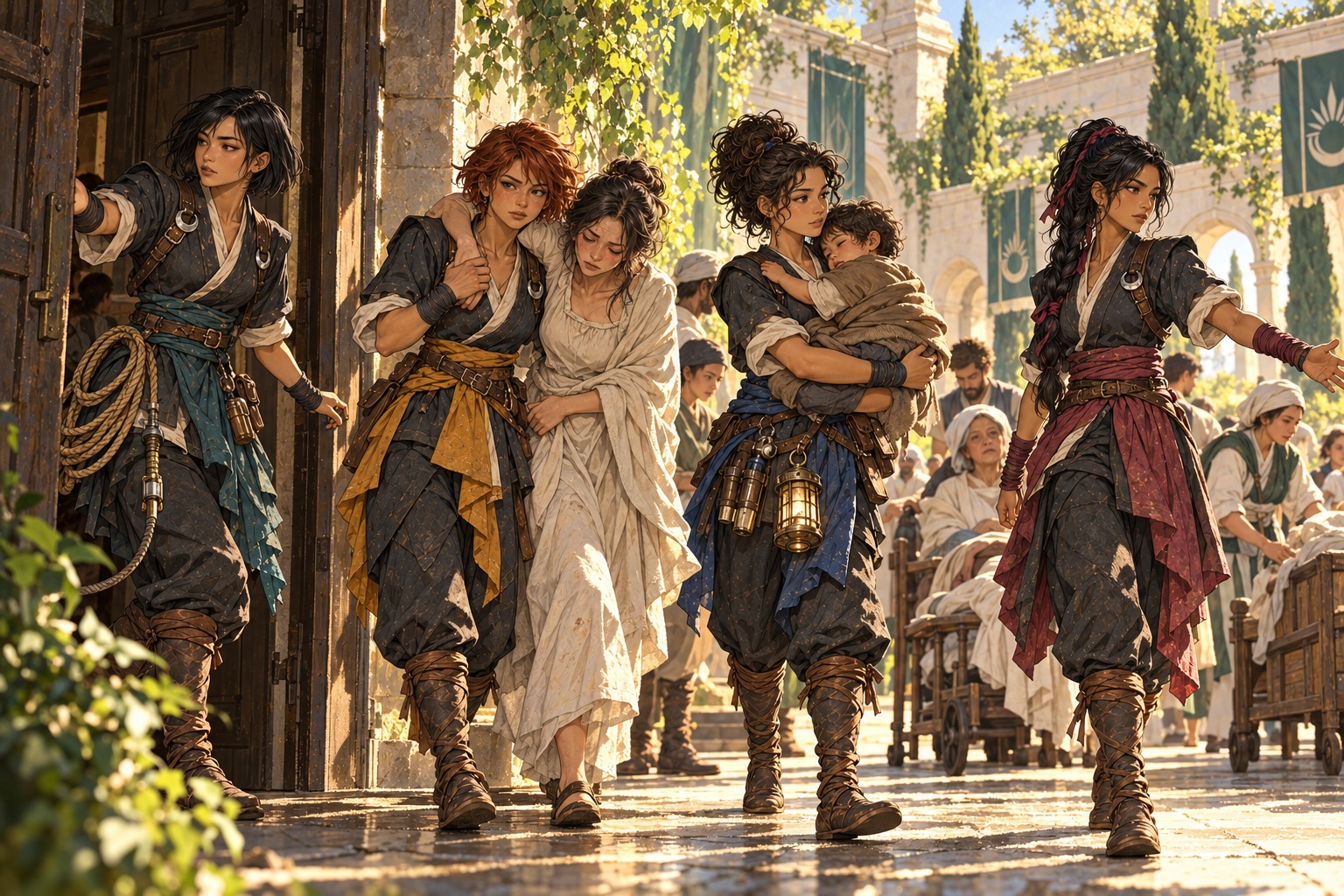
Mae opened the west service door and came through supporting a woman in a nightshirt.
Behind them, an attendant wheeled a bed. Sena left the cue desk only after Rin had secured the disconnect, crossed to the doorway and lifted a child onto her back. The child was awake, furious and unwilling to leave her shoes. Sena waited while Mae fetched them.
The sight travelled farther than Sori's voice.
A man by the second row moved his bench. Another told him he was blocking the view, then saw the trolley and got up. Within a minute there was a path wide enough to bring the next bed through. It was not orderly enough to look rehearsed. That was one reason people began to believe it was real.
Rin stayed at the desk. The clerk reached for the switch.
“If you reconnect that,” she said, “put your name beside the time.”
He looked at the inventory. Sori's folder lay open beneath it, the cancelled contract exposed. Evidence of a dispute, yes. Also evidence that four women had brought their own equipment, disconnected their own cable and told a supervisor what they were doing.
He took his hand away.
At the north gate, Hesh heard the first closure warning while the freight steward was still unlocking the winch house.
“Quicker,” she said.
He swore at the key. One of the workers climbed the side ladder to see whether the bar could be blocked from above. It had already begun to descend.
Hesh drove the short half of her spear under it.
Ashwood bowed. The gate stopped with space beneath it for a stooping person, not a chair. She put her shoulder to the bar and pushed. The long spear half lay tied against the wall, iron head wrapped so it would not catch a passer-by. For once it had nothing useful to threaten.
Two students came toward the gate. One saw the trapped wood and knelt to help. The other remained upright in the middle of the opening, lips moving through an exercise count.
“What is his name?” Hesh asked.
The kneeling student stared at her.
“His name.”
“Amren.”
Hesh said it. No response. She had not expected a stranger's knowledge to be enough, but fear made her try anyway.
“You tell him,” she said to the friend.
The student rose, put a hand on Amren's sleeve and spoke beside his ear. Not a command. An argument about a bread roll stolen at breakfast. Amren's eyes came around for a moment. They pulled him out of the gate before the moment closed.
The freight steward reached the winch. The counterweight stopped dropping, but the bar remained where Hesh's spear held it. Someone had to keep it lifted while the trolleys passed. The two students stayed. A porter came to take Hesh's left side.
More hands, each arriving with a different reason, no single invitation holding them all in place.
Below the city, Virelia opened the first sanctuary passage.
Tovan confirmed the next room was clear. Den stayed beside the new root connection. Gorrath sat near enough to see both the girl and the patients waiting to move. The basket of removed tiles remained covered in a locked stone cabinet, listed one by one. No one would be made to carry them through a crowd because their owners were leaving.
The first patient was Rovan. He refused the trolley until Lysa could stand beside it. Tovan waited. The refusal delayed three other people and prevented a panic the delay would never be credited for averting.
Virelia's hand lifted toward the central lattice.
Gorrath touched her wrist.
She stopped. The doors remained as they were: one open, the next still closed, the people between allowed enough time to occupy the journey.
“I can do more,” Virelia whispered.
Tovan answered from the passage. “We haven't asked for more.”
The girl closed her fingers against her own knee. Den watched the little root in its dish, waiting until the pressure on it eased.
Not all the patients moved. Meret was too unstable. Alis's daughter had arrived and would not leave while her mother slept, but was willing to remain with an attendant rather than block the aisle in terror. Two older men chose to stay because they understood the room and could not face the crowd outside. Their names were written on the board, with who would stay beside them and how help would be called.
Gorrath read each entry before Hesh's freight copy was sent upstairs. She insisted on space for the people who might change their minds.
In the main court, Vale pulled the disc's covering free.
The branching mark flared above the dais.
He did not wait for the programme clerk or the quartet's absence to be explained. The first teaching rank had already begun the shared opening. Across the court, hands found grips, sleeves lifted, blades rose into the positions Deren had corrected on paper months before.
Some people joined because the movement was familiar. Others because those beside them had joined and a public refusal was more frightening than the lesson. The carrier took the offered sequence and made the difference between those reasons less important with every completed step.
Deren stood by the platform rail with both hands pressed to the wood.
Mali emerged behind him, unarmed.
She said his name.
He turned. For a moment he looked at her as he had at the examination gate, seeing the injury before deciding what it meant. His gaze went to her empty belt.
“Where is your sword?”
“I left it.”
“You can't face him without one.”
“I came for you.”
Below the platform, Ember tested the handset once more. Boon's voice came through, thin but intelligible. The glass return ring had begun to glow where it joined the bronze collar. He could see the two halves, the conductive ends that would need separating after the archive margin closed.
He set his hammer beside his foot and cleared a broken floor brace from the gap, one slow movement at a time.
“Clear,” he told the line.
Above him, the first ranks turned toward Mali.
The doors were opening. The lesson had not ended.